
Cover Letter Guide for Beginners: How to Write a Professional Cover Letter
A cover letter is your opportunity to introduce yourself personally to an employer. While your CV lists your qualifications and skills, your cover letter explains why you are applying for the role and why you are a good fit for the company. This guide explains every section of a professional cover letter and shows you how to write one with confidence — even if you have no experience.
What Is a Cover Letter?
A cover letter is a one-page document sent with your CV when applying for a job. Its purpose is to explain your interest in the role, highlight relevant skills, and demonstrate that you have researched the company. A strong cover letter increases your chances of getting an interview.
Why a Cover Letter Is Important
- Shows motivation and genuine interest in the role
- Allows you to explain your skills in context
- Demonstrates communication and writing ability
- Helps employers understand your career goals
- Sets you apart from candidates who do not include one
Cover Letter Structure
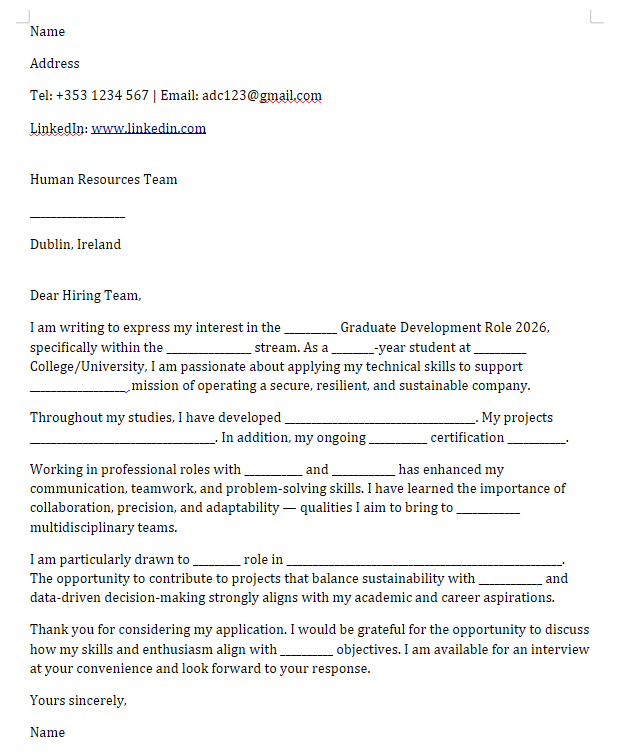
A professional cover letter follows a clear structure. Keeping the correct format makes your letter easy to read and professional in appearance.
- Header (your contact details)
- Date
- Employer’s details
- Greeting (salutation)
- Opening paragraph
- Main body paragraphs
- Closing paragraph
- Formal sign-off
Header: Your Contact Information
The header appears at the top of your cover letter. It should match the font and style of your CV to maintain consistency.
- Your full name
- Address (optional)
- Phone number
- Professional email address
- LinkedIn profile (optional)
Greeting the Employer Correctly
Always try to address your cover letter to a specific person. This shows professionalism and effort.
- Dear Ms. Surname (female)
- Dear Mr. Surname (male)
- Dear Hiring Manager (if name is unknown)
- Dear Sir/Madam (last resort)
Opening Paragraph: Introduce Yourself
The opening paragraph should clearly state the position you are applying for, where you found the job advertisement, and your interest in the role.
Example:
Please find attached my CV for the position of [Job Title] with [Company Name],
as advertised on [source]. I am very interested in this opportunity and believe
it aligns well with my education and career goals.
Main Body: Match Your Skills to the Job
This is where you explain why you are suitable for the role. Match your skills, qualifications, and experience to the job description.
- Refer directly to skills listed in the job description
- Mention relevant coursework, projects, or internships
- Highlight achievements, not just responsibilities
- Explain what value you can bring to the company
Demonstrating Company Research (Very Important)
Employers want to see that you have researched their organization. This paragraph is often the most important part of the cover letter.
- Mention company values or mission statement
- Refer to recent news, projects, or achievements
- Explain why the company appeals to you specifically
- Connect your values and goals to theirs
Closing Paragraph
The closing paragraph should be polite, confident, and forward-looking. Thank the employer and express interest in an interview.
Thank you for your time and consideration. I would welcome the opportunity to discuss this role further and am available for interview at your convenience. I look forward to hearing from you.
Final Formatting Tips
- Keep your cover letter to one page
- Use the same font and style as your CV
- Avoid bright colors and decorative fonts
- Proofread carefully for spelling and grammar
- Save as PDF unless stated otherwise
Next Step in Your Career Journey
Once your cover letter is ready, you can confidently apply for beginner-friendly jobs and internships using your professional CV and cover letter.
Find Beginner-Friendly Jobs